
 Language
 Chinese
 German
 French
 Italian
 Spanish
 Turkish
 Arabic
 Dutch
Dutch






Looking to enhance your projects with top-notch sealing solutions?
Eager to discover more about Sonkit's innovative services and offerings?
Connect with our expert team now and let's start a conversation!
Injection Molding
Metal C-ring seals keep molten polymer inside the heated flow path of injection-molding equipment. The usual duty is a hot-runner joint: a compact groove, repeated heat-up and shutdown, and pressure pulses during fill and pack. Elastomer seals lose capability in that window. A pressure-energized metal C-ring is specified to hold contact stress through the cycle without crushing the gland or leaving a melt leak path that later carbonizes.
This page is an application overview. For alloy, coating, groove, and preload detail, use the technical article Designing Metal C-Rings to Survive 400°C and 40 MPa in Hot Runner Systems. For product geometry and options, see the Metal C-Ring family.
Where metal C-rings are used
- Hot-runner manifolds, nozzle interfaces, and valve-gate assemblies — the seal holds melt pressure at the heated joint and blocks leakage into the split line.
- Polymer transfer paths — the same requirement along the melt-delivery line between the injection unit and the cavity.
- Melt filters — the seal keeps molten plastic inside the filter housing during purification.
- Chemical-fiber spinnerets — related high-temperature polymer service listed on Sonkit’s injection-molding case page.
Typical hot-runner conditions
The figures below are the injection-molding / hot-runner values already published by Sonkit. They are not nuclear ratings and not the wider catalog envelope shown on the general C-ring product page.
| Parameter | Published value | Source |
|---|---|---|
| Temperature | −50°C to 400°C; severe-duty land temperature near 400°C | Case page; hot-runner article |
| Pressure | Vacuum to 40 MPa; 40 MPa treated as a severe-duty pulse level | Case page; hot-runner article |
| Medium | Molten plastics and synthetic fibers | Case page |
| Seal type | Internally open, spring-energized metal C-ring (thin-wall C section) | Case page |
| Gland machining | ±0.05 mm cited for compact installation spaces | Case page |
The case page also reports a leak rate of 1 × 10⁻⁸ Pa·m3/s under its published test conditions, with no leakage detected at 40 MPa in that test. Treat those figures as case data for the stated setup, not a blanket rating for every groove.
Role of the metal C-ring
A metal C-ring is a thin-walled C-section static seal. Installed with the opening toward system pressure, process pressure assists the seating load. Compared with a solid gasket, the C profile stores elastic recovery (springback) and needs a lower bolting load. That combination matches hot-runner hardware: limited groove volume, thermal growth of plates and bolts, and polymer pressure that will extrude into any open clearance.
Sonkit supplies this as a standard Metal C-Ring or a spring-energized Metal C-Ring. The spring-energized variant is the type described on the injection-molding case page when the joint needs a more consistent seating load on a compact land.
Advantages in hot-runner service
- Temperature in the hot-runner window. The joint is designed around continuous land temperature near 400°C, including start-stop cycles, not a reactor rating.
- Pressure pulses, not vessel containment. Injection and packing can approach 40 MPa. The C opening is oriented so pressure loads the lips into the land instead of peeling them away.
- Recovery after thermal cycles. Leaks often appear after shutdown, resin change, or uneven heat — not at first assembly. The C-ring is specified for remaining springback, not one-time crush.
- Molten-polymer compatibility. The duty is melt leakage and carbonized deposits in the groove, not gas permeation through a containment boundary.
- Compact glands. Thin-wall C-rings with the published ±0.05 mm machining tolerance are used where installation space is limited.
Groove and preload checklist
A C-ring only seals if the groove and bolt load leave it in its elastic working range after the manifold is hot. Use this as a short release check; the full argument is in the 400°C / 40 MPa hot-runner article.
- Confirm temperature at the sealing land, not only the heater setpoint.
- Define maximum pressure and pressure direction (injection, packing, startup).
- Set groove depth so target compression is valid at room temperature and at operating temperature.
- Limit side clearance so melt cannot extrude and carbonize.
- Break sharp groove corners that score plating or start a leak path.
- Orient the C opening toward pressure so the joint is pressure-assisted.
- Control preload with a positive stop, measured closure, or a defined torque sequence.
- Inspect the land for scratches and carbon residue before reassembly.
Design note. A seal that looks closed at room-temperature assembly can lose margin at temperature if bolt stretch, manifold growth, and seal springback are not checked together. Specify the groove with the seal, not after the manifold is hardened.
Related pages
- Technical article: Designing Metal C-Rings to Survive 400°C and 40 MPa in Hot Runner Systems
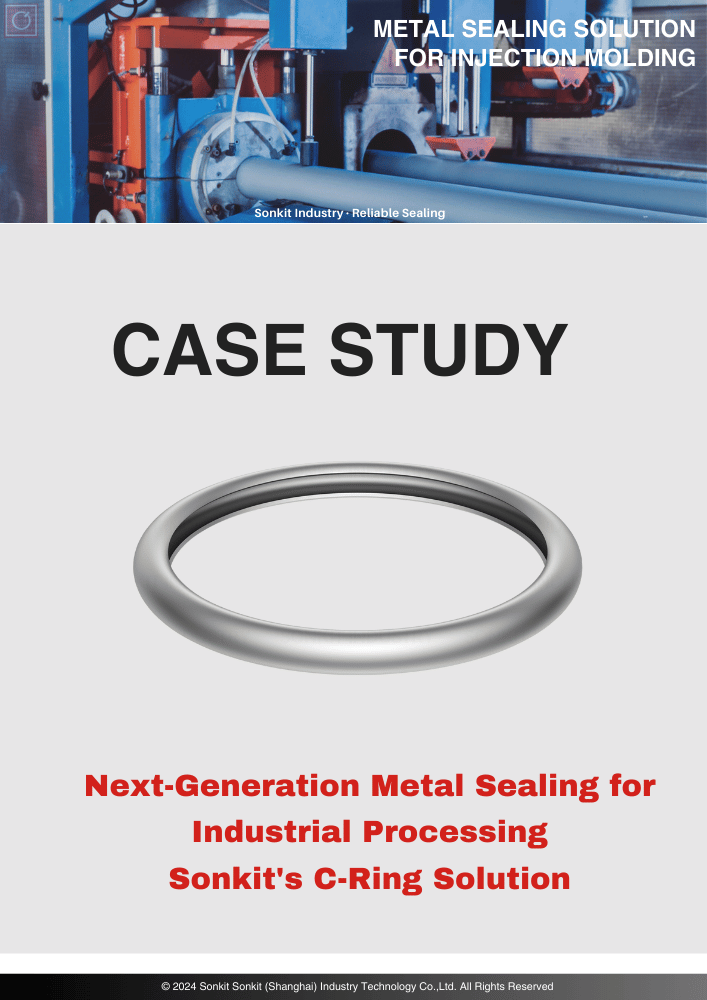
- Case study: Injection Molding Metal Sealing Solutions
- Metal C-Ring product family
- Contact Sonkit — send the groove drawing, land temperature, pressure direction, and resin. Email: johnny@sonkit.cn
